Why Digital Simulation Matters for More Effective Training
Digital simulation allows learners to study procedures and experience different scenarios in a virtual environment. This approach can help connect theoretical knowledge with practical experience.
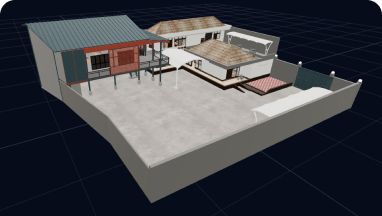
Why Digital Simulation Matters for More Effective Training
Training plays an important role in helping people understand their responsibilities, procedures, and technical systems.
However, not every subject can be effectively learned through presentations or written documentation alone.
Some tasks require practical experience to fully understand how a procedure works.
Digital simulation provides an alternative approach by recreating specific conditions, processes, or environments in a digital format.
Learners can explore different scenarios and perform actions without immediately entering the real-world environment.
What Is Digital Simulation?
Digital simulation is the representation of a condition, process, or system within a digital environment.
A simulation can be relatively simple, such as a visual representation of a process, or highly interactive with 3D environments, animations, user interactions, and evaluation systems.
Digital simulations can represent:
Machines and equipment
Work environments
Operational procedures
Production processes
Safety scenarios
Technical systems
Specific operational conditions
The goal is to provide an environment where users can learn and understand how a system or process works.
Why Is Simulation Useful for Training?
Not every real-world condition is easy to use as a training environment.
For example, a company may want to train employees on the operation of industrial machinery. Using the actual equipment for every training session may require significant preparation and coordination.
Digital simulation can provide an environment where some of the learning can take place before practical training.
Learners can become familiar with the structure, procedures, and sequence of actions before working with the actual equipment.
Connecting Theory with Practice
One challenge in training is turning theoretical knowledge into practical skills.
A learner may understand a procedure from a manual or presentation but still struggle to apply it in a real situation.
Simulation can act as a bridge between the two.
Instead of simply reading a procedure, learners can experience how that procedure is applied within a specific scenario.
Creating Different Scenarios
One of the advantages of digital simulation is the ability to create different conditions.
A training system can include several scenarios, such as:
Normal Scenario
The learner performs the standard operating procedure.
Error Scenario
The learner encounters an unexpected error during the process.
Emergency Scenario
The learner must follow specific procedures when an emergency situation occurs.
This approach allows learners to study more than one operating condition.
Digital Simulation for Safety Training
Workplace safety is an area where digital simulation can be particularly useful.
Certain situations that may be difficult or risky to recreate physically can be represented within a digital environment.
Learners can practice identifying specific conditions and following appropriate procedures.
Simulation can also demonstrate the consequences of certain actions, helping learners understand the importance of following established procedures.
Digital Simulation for Industry
In industrial environments, simulation can support many types of training.
Examples include machine introduction, production processes, maintenance procedures, and operator training.
3D models can represent machines and equipment, while animations can demonstrate how components move and operate.
This combination provides learners with a clearer understanding of the system being studied.
The Role of 3D Technology
3D technology can be an important component of digital simulation.
Machines, vehicles, buildings, and equipment can be represented as three-dimensional models.
These models can then be combined with animations and interactions.
For example, a machine can be recreated as a 3D model and animated to demonstrate how its components move during operation.
Simulation Does Not Always Require VR
Digital simulation is often associated with Virtual Reality, but simulation does not necessarily require VR hardware.
Simulations can be delivered through:
Desktop applications
Interactive websites
Mobile applications
Virtual Reality
Augmented Reality
The appropriate platform depends on the training objectives, number of users, available hardware, and organizational requirements.
Benefits for Organizations
Digital simulation can provide several benefits for training programs.
More Interactive Learning
Learners can directly interact with the system being studied.
Better Visualization
Complex concepts can be represented through models, animations, and digital environments.
Repeatable Training
Learners can repeat scenarios to reinforce their understanding.
Controlled Environments
Training scenarios can be designed and controlled according to specific requirements.
Scalable Development
A simulation can start with a simple scenario and gradually expand into a more advanced training system.
Challenges in Simulation Development
Developing a digital simulation requires more than creating attractive visuals.
Teams need to understand the training objectives, user requirements, processes being simulated, and interactions that learners need.
Other considerations include 3D model quality, application performance, interface design, and overall user experience.
A highly complex simulation is not necessarily better if it does not address the actual training objectives.
Measuring Simulation-Based Training
Digital simulations can include evaluation systems that track how learners complete a scenario.
For example, a system may record:
Actions performed
Completion time
Errors made
Successfully completed scenarios
Evaluation results
This information can help instructors and organizations understand the training process and identify areas that may require improvement.
The Future of Digital Simulation
Advances in AI, 3D, VR, AR, and cloud technologies are creating new possibilities for digital simulation.
AI can support more dynamic scenarios, while 3D technology can provide increasingly detailed visual environments.
By combining these technologies, digital simulation can become part of a more integrated training ecosystem.
Conclusion
Digital simulation provides a way for learners to understand procedures, systems, and different conditions through controlled digital environments.
By combining 3D, animation, interaction, VR, AR, and other technologies, simulations can support many training requirements, from product education to industrial and safety training.
The most important factor is not simply the technology itself, but how the simulation is designed around learning objectives and user needs.