Virtual Reality in Training: Creating More Interactive and Immersive Learning
Virtual Reality creates new opportunities for training by providing interactive and immersive simulated environments. It can help learners understand procedures and experience different scenarios in a controlled environment.
Virtual Reality in Training: Creating More Interactive and Immersive Learning
Digital technology continues to transform how companies train and develop their employees.
One technology that is increasingly being explored for training is Virtual Reality (VR).
Using VR devices, learners can enter virtual environments and interact with digital objects and scenarios designed for specific training purposes.
This approach provides a more interactive learning experience compared with conventional training methods.
What Is Virtual Reality?
Virtual Reality is a technology that creates a digital environment designed to provide users with an immersive experience.
Users typically interact with the environment through a VR headset. Some systems also use controllers or other input devices to allow users to interact with virtual objects.
Virtual environments can be designed to replicate real-world locations or create completely digital scenarios.
Why Use VR for Training?
Traditional training often relies on presentations, manuals, demonstrations, and classroom instruction.
VR provides a different approach.
Learners can be placed directly into a simulated scenario and asked to perform specific actions based on the training objectives.
For example, a company can create a virtual workplace where employees can learn safety procedures without having to immediately enter the actual work environment.
Benefits of Virtual Reality Training
1. More Interactive Learning
VR allows learners to interact directly with the virtual environment.
Instead of simply receiving information, users can perform actions and observe system responses.
2. Work Environment Simulation
Some workplaces can be difficult to use as training environments.
VR can digitally recreate these environments and allow learners to become familiar with equipment, locations, and procedures.
3. Safety Training
VR can be used to simulate safety scenarios and provide learners with opportunities to practice procedures within a controlled digital environment.
4. Practical Learning Experience
Training can combine theoretical information with interactive virtual practice.
5. Consistent Training Scenarios
Training scenarios can be designed and reused so that different learners can experience the same learning environment.
Examples of VR Training
VR can be applied to various training scenarios.
Industrial Training
VR can introduce machinery, production facilities, and operational procedures.
Safety Training
Virtual scenarios can demonstrate different workplace conditions and safety procedures.
Maintenance Training
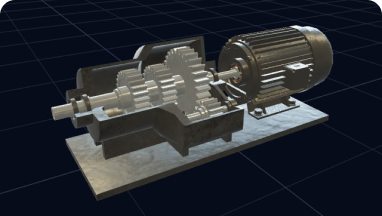
Technicians can explore machine components and maintenance procedures using interactive 3D models.
Product Training
Companies can create virtual product demonstrations for employees, customers, or partners.
VR and 3D Technology
Virtual Reality is closely connected to 3D technology.
VR environments require digital objects and spaces that can be displayed in three dimensions.
3D models can represent:
Machines
Equipment
Buildings
Rooms
Products
Vehicles
Work environments
These objects can then be placed into virtual environments and combined into training scenarios.
VR Is More Than Visual Technology
The purpose of VR training is not simply to make learning look more impressive.
The more important factor is how the technology supports learning objectives.
VR scenarios should be designed around the needs of the learners. Content, interactions, instructions, and evaluation should all be considered during development.
When designed properly, VR can combine visualization, interaction, and simulation into a single learning experience.
Challenges of VR Implementation
VR training also requires careful planning.
Organizations need to consider the development of virtual environments, VR hardware, software, infrastructure, and user capabilities.
User experience is also important. A simulation that is too complex or poorly designed may make the training experience more difficult to follow.
Therefore, VR should be implemented based on clearly defined training requirements.
The Future of VR Training
Advances in VR, 3D, AI, and interactive technologies are opening new opportunities for training.
Future systems can combine virtual environments with learning analytics and evaluation systems to provide more structured training experiences.
These technologies can help organizations create digital learning environments that are more interactive and aligned with specific training objectives.
Conclusion
Virtual Reality provides a new approach to training by creating interactive and immersive simulated environments.
It can support industrial training, safety training, maintenance, product demonstrations, and many other learning scenarios.
Combined with 3D technology and well-designed training scenarios, VR can help connect theoretical knowledge with practical experience in a digital environment.